April 24, 2012


Press Conference at UN HQ in Geneva, Launch of Lend Your Leg campaign, 1st March 2012.
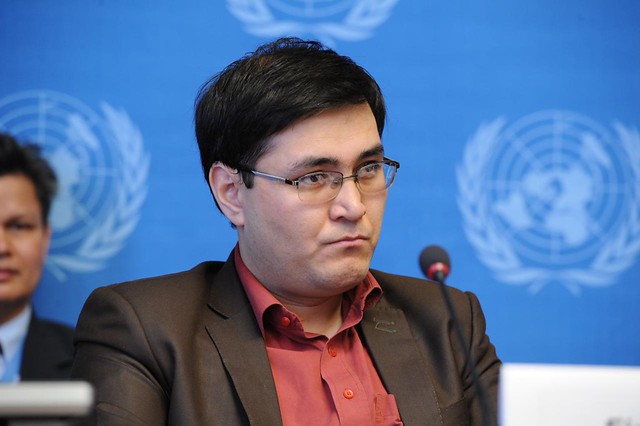
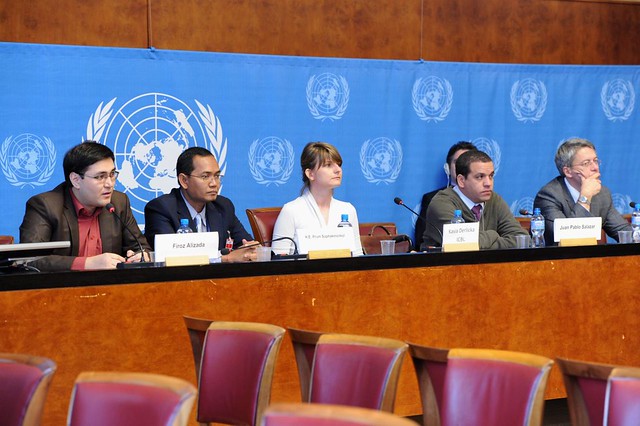
UNMAS press conference
Firoz Alizada, ICBL Campaign Manager and Afghan landmine survivor addresses during the Press Conference of the "Lend your leg" campaign launch. Room III, Palais des Nations, Geneva. Thursday 1March 2012. Photo by Violaine Martin.
UNMAS press conference
The Press Conference of the "Lend your leg" campaign launch. Room III, Palais des Nations, Geneva. Thursday 1 March 2012. Photo by Violaine Martin
Source: http://www.flickr.com/photos/unisgeneva/6797587628/in/photostream/
Global Anti-Landmine Campaign Launched
Landmine survivors worldwide on Thursday launched an international campaign aimed at eradicating these weapons. The start of the "Lend your leg for a mine-free world" campaign marks the entry into force 13 years ago of what is commonly known as the Mine Ban Treaty.
Much progress has been made in ridding the world of landmines and reducing casualties from these weapons since the Mine Ban Treaty began. Eighty percent of countries have banned landmines. Most no longer produce them, and millions of mines have been removed.
But landmines continue to kill, maim and threaten people. That is why the International Campaign to Ban Landmines, the United Nations, and other partners, celebrities and survivors are launching the “Lend your leg for a mine-free world” campaign.
This video shows personalities, including the U.N. Secretary-General Ban Ki-moon, Israeli film-maker Oren Moverman, Somalia survivor Muhudin nur Hassan and others rolling up their pant legs in a show of solidarity with landmine survivors.
Campaigners are asking people around the world to join them by rolling up their pant legs on April 4 - U.N. Day for Mine Action and Mine Awareness.
Until then, campaigners will be organizing concerts, sporting and other events to urge people to participate in the cause.
Firoz Alizada is Campaign Manager for the International Campaign to Ban Landmines. An Afghan landmine survivor, Alizada lost a leg in a mine explosion when he was 14-years-old. He said landmines and similar devices wreak havoc on peoples’ lives and livelihoods.
“There is still an average of 12 people who are maimed or killed by mines or explosive remnants of war per day or 4,000 per year, which is a lot - some of whom die on the spot, some of whom die in the hospital and cannot make it. Mines are present and still affect peoples lives in more than 60 countries,” said Alizada.
During the past two years, the International Campaign says several governments - Burma, Israel, Libya and probably Syria - have used landmines. In addition, non-state groups in Afghanistan, Colombia, Burma and Pakistan have used them.
Source:http://www.voanews.com/english/news/europe/Global-Anti-Landmine-Campaign-Launched-141078353.html
Photo: AP -  Firoz Ali Alizada (L), a landmine victim and campaign manager for the International Campaign to Ban Landmines and Austrian Foreign Minister Michael Spindelegger speak to the press, at the European headquarters of the United Nations in Geneva, Switzerland, September 2009.
Firoz Ali Alizada (L), a landmine victim and campaign manager for the International Campaign to Ban Landmines and Austrian Foreign Minister Michael Spindelegger speak to the press, at the European headquarters of the United Nations in Geneva, Switzerland, September 2009. Landmine survivors worldwide on Thursday launched an international campaign aimed at eradicating these weapons. The start of the "Lend your leg for a mine-free world" campaign marks the entry into force 13 years ago of what is commonly known as the Mine Ban Treaty.
Much progress has been made in ridding the world of landmines and reducing casualties from these weapons since the Mine Ban Treaty began. Eighty percent of countries have banned landmines. Most no longer produce them, and millions of mines have been removed.
But landmines continue to kill, maim and threaten people. That is why the International Campaign to Ban Landmines, the United Nations, and other partners, celebrities and survivors are launching the “Lend your leg for a mine-free world” campaign.
Campaigners are asking people around the world to join them by rolling up their pant legs on April 4 - U.N. Day for Mine Action and Mine Awareness.
Until then, campaigners will be organizing concerts, sporting and other events to urge people to participate in the cause.
Firoz Alizada is Campaign Manager for the International Campaign to Ban Landmines. An Afghan landmine survivor, Alizada lost a leg in a mine explosion when he was 14-years-old. He said landmines and similar devices wreak havoc on peoples’ lives and livelihoods.
“There is still an average of 12 people who are maimed or killed by mines or explosive remnants of war per day or 4,000 per year, which is a lot - some of whom die on the spot, some of whom die in the hospital and cannot make it. Mines are present and still affect peoples lives in more than 60 countries,” said Alizada.
During the past two years, the International Campaign says several governments - Burma, Israel, Libya and probably Syria - have used landmines. In addition, non-state groups in Afghanistan, Colombia, Burma and Pakistan have used them.
Source:http://www.voanews.com/english/news/europe/Global-Anti-Landmine-Campaign-Launched-141078353.html
My interveiw with Los Angeles Times -

When he was 13 years old, Firoz Ali Alizada lost both his legs to a land mine while trying to take a shortcut to school north of Kabul, Afghanistan.
Sixteen years later, he is the campaign manager for the International Campaign to Ban Landmines, which marks the International Day for Mine Awareness on Wednesday. The Times asked him to share his story.
What happened after you stepped on the mine?
I did not expect to survive. We were about three hours' walk from the main road. It took me about six to seven hours to get first aid. We had to go to the home of the doctor because it was late and there was no clinic. He just tried to stop the bleeding with a tourniquet. Then we went to the proper hospital, which was [about 40 miles] away.
On the way to the hospital I lost consciousness. I didn’t know what happened. Later they told me the Taliban was very close to the hospital and they were approaching, and everybody was running away. It was difficult to keep the doctors. My brother had to pay a lot of money to the surgeon for him to do the operation. The next day, around 4 o’clock, I woke up and discovered that they already did the amputation -- my right leg below the knee and the left above the knee.
I was kind of surprised that I was still alive. When I was in the hospital, I saw another person who was close to me and he died in front of my eyes. Not because he was severely injured but because nobody was taking care of him.
Before you were injured, what did you know about land mines?
We did not receive any kind of proper education about land mines. Since I grew up, from the very beginning I used to see -- not land mines per se, maybe because it was all hidden -- but I used to see the sub-munitions, unexploded ordnance and all types of explosives that [remained from] the war. I used to play with some of them; it looked quite attractive when I was around 7 or 8 years old.
Now I know it’s called BLU-97, a ... cluster bomb. My family used to say, “You have to be careful, don’t touch these things.” But nobody told us, “Don’t go in this place because it is contaminated by land mines.” People were not scared or anything until there was an explosion or an accident. It was a kind of part of people’s lives. People would see it as very normal.
How did your injuries affect your life?
It totally changed my life. I used to be a very naughty teenager. I was with a bunch of friends, always out, playing around the village, volleyball, football. But all those things were taken away.
U.S. must join mine ban convention, land mine survivor says
When he was 13 years old, Firoz Ali Alizada lost both his legs to a land mine while trying to take a shortcut to school north of Kabul, Afghanistan.
Sixteen years later, he is the campaign manager for the International Campaign to Ban Landmines, which marks the International Day for Mine Awareness on Wednesday. The Times asked him to share his story.
What happened after you stepped on the mine?
I did not expect to survive. We were about three hours' walk from the main road. It took me about six to seven hours to get first aid. We had to go to the home of the doctor because it was late and there was no clinic. He just tried to stop the bleeding with a tourniquet. Then we went to the proper hospital, which was [about 40 miles] away.
On the way to the hospital I lost consciousness. I didn’t know what happened. Later they told me the Taliban was very close to the hospital and they were approaching, and everybody was running away. It was difficult to keep the doctors. My brother had to pay a lot of money to the surgeon for him to do the operation. The next day, around 4 o’clock, I woke up and discovered that they already did the amputation -- my right leg below the knee and the left above the knee.
I was kind of surprised that I was still alive. When I was in the hospital, I saw another person who was close to me and he died in front of my eyes. Not because he was severely injured but because nobody was taking care of him.
Before you were injured, what did you know about land mines?
We did not receive any kind of proper education about land mines. Since I grew up, from the very beginning I used to see -- not land mines per se, maybe because it was all hidden -- but I used to see the sub-munitions, unexploded ordnance and all types of explosives that [remained from] the war. I used to play with some of them; it looked quite attractive when I was around 7 or 8 years old.
Now I know it’s called BLU-97, a ... cluster bomb. My family used to say, “You have to be careful, don’t touch these things.” But nobody told us, “Don’t go in this place because it is contaminated by land mines.” People were not scared or anything until there was an explosion or an accident. It was a kind of part of people’s lives. People would see it as very normal.
How did your injuries affect your life?
It totally changed my life. I used to be a very naughty teenager. I was with a bunch of friends, always out, playing around the village, volleyball, football. But all those things were taken away.
I could not return to my village because it wasn’t physically accessible for me.... Since '96 I have been there only three times. They operated on me seven times because the first operation was not done properly. For a while I could not go to school.We had to leave our place because Taliban came, and I am from a minority and we were targeted. We immigrated to Peshawar, Pakistan. My family had to spend whatever they had on my operation and my recovery. Everyone was just thinking for me to survive. My brother had to leave his job. He was doing agriculture. My father had to quit his job. It was all because of this accident.
Even after we recovered economically, still my family remained psychologically affected because I think people with a disability are seen as a burden. You’re a cripple. One reason that I’m in Geneva is because of this discrimination.
What had you dreamed of doing when you were young -- and what did you end up doing?
When I was young I had totally different plans. I wanted to be a pilot. I wanted to be a police officer. Now I’m happy with my life. I think I overcame a lot of challenges thanks to the support of my family. The International Committee of the Red Cross helped me a lot, providing me a leg and wheelchair. Then I got a job with Handicap International -- as soon as I had a job I felt the difference in my life.
Now I work with this campaign. I’m one of the luckiest among the survivors. I’m married now and I have a kid. All of this makes me feel happy. But when I think about tens of thousands of other survivors living in mine-affected countries and other people with disabilities living in these countries, I really don’t know when the situation will change for them. The problem is so huge.
What needs to be done to help survivors?
Most survivors you ask, what do they want? They’d say a job, some way to feed their family or to feed themselves. It is very important that the states should think about better ways of creating job opportunities for survivors and make sure that they are an active part of the society.
Only 9% of the funding that goes to mine action went to victim assistance, which is not enough. Most of the money goes to get rid of land mines, which is great. I’m not saying they should take money away from mine clearance. But there is a need for more assistance.
What more could the United States and the rest of the international community be doing?
It will be a huge thing if the United States joins the mine ban convention.There are 37 countries that did not join the mine ban convention, which means they may have a stockpile of mines. [Under the Mine Ban Treaty, countries agree not to use, produce or transfer antipersonnel mines, to destroy their stockpiles within four years and to clear any mined areas in their territory within 10 years.]
Some of them think they might need to use them at some point. Some say, “Because my neighbor did not join I am not joining.” We are hoping for a world free of land mines in our lifetime. That’s not possible without having these countries join the convention.
http://latimesblogs.latimes.com/world_now/2012/04/landmine-survivor-international-day-mine-awareness.html
Even after we recovered economically, still my family remained psychologically affected because I think people with a disability are seen as a burden. You’re a cripple. One reason that I’m in Geneva is because of this discrimination.
What had you dreamed of doing when you were young -- and what did you end up doing?
When I was young I had totally different plans. I wanted to be a pilot. I wanted to be a police officer. Now I’m happy with my life. I think I overcame a lot of challenges thanks to the support of my family. The International Committee of the Red Cross helped me a lot, providing me a leg and wheelchair. Then I got a job with Handicap International -- as soon as I had a job I felt the difference in my life.
Now I work with this campaign. I’m one of the luckiest among the survivors. I’m married now and I have a kid. All of this makes me feel happy. But when I think about tens of thousands of other survivors living in mine-affected countries and other people with disabilities living in these countries, I really don’t know when the situation will change for them. The problem is so huge.
What needs to be done to help survivors?
Most survivors you ask, what do they want? They’d say a job, some way to feed their family or to feed themselves. It is very important that the states should think about better ways of creating job opportunities for survivors and make sure that they are an active part of the society.
Only 9% of the funding that goes to mine action went to victim assistance, which is not enough. Most of the money goes to get rid of land mines, which is great. I’m not saying they should take money away from mine clearance. But there is a need for more assistance.
What more could the United States and the rest of the international community be doing?
It will be a huge thing if the United States joins the mine ban convention.There are 37 countries that did not join the mine ban convention, which means they may have a stockpile of mines. [Under the Mine Ban Treaty, countries agree not to use, produce or transfer antipersonnel mines, to destroy their stockpiles within four years and to clear any mined areas in their territory within 10 years.]
Some of them think they might need to use them at some point. Some say, “Because my neighbor did not join I am not joining.” We are hoping for a world free of land mines in our lifetime. That’s not possible without having these countries join the convention.
http://latimesblogs.latimes.com/world_now/2012/04/landmine-survivor-international-day-mine-awareness.html
Subscribe to:
Posts (Atom)